Maldek by Hill · A Hill Clinical Learning System
For educators · schools & programs
Your students’ first patient shouldn’t be a real one.
Maldek drops students into interactive patient mysteries — they investigate, commit to a diagnosis, and ride the Time Machine backward through the pathophysiology. Not one multiple-choice question in sight.
Built for
- Nursing program directors
- Sim-lab coordinators & clinical instructors
- High school health-science CTE teachers
- Career & Technical Education directors
- HOSA advisors & pre-med club leads
Built specifically for
Two kinds of schools that already teach healthcare.
Healthcare-related programs
Nursing, PA, and allied-health programs
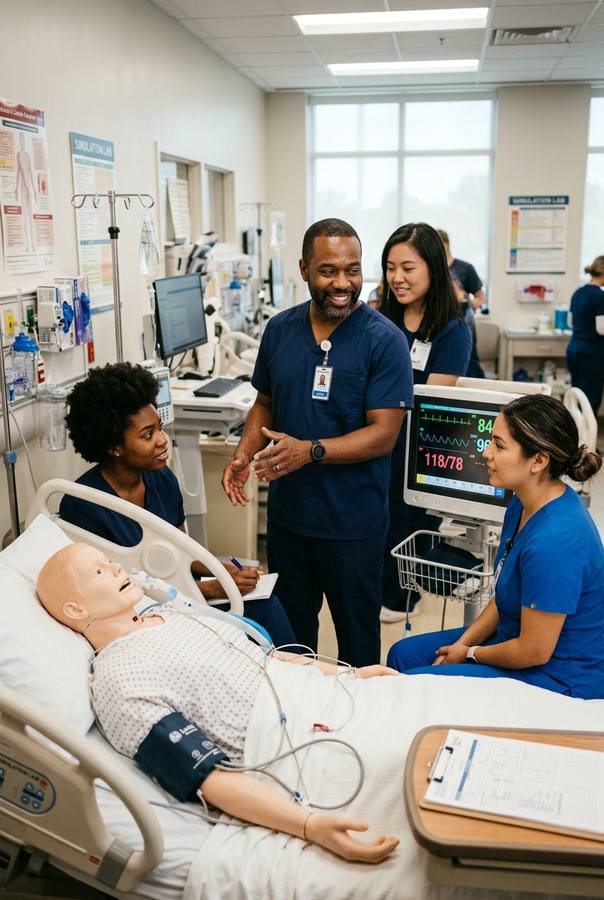
For programs that need to teach real clinical reasoning — not memorization. Maldek simulates the cognitive load of a shift, captures the decision path, and shows instructors exactly where each cohort’s thinking breaks down.
- ·BSN / MSN / allied-health curricula
- ·Sim-lab pre-brief + debrief tooling
- ·Per-cohort analytics + weakest-step tracking
- ·One-page pilot reports for accreditation files
High school CTE pathways
High schools with healthcare CTE programs
For Career & Technical Education tracks in Health Science, Patient Care, Sports Medicine, Pharmacy Tech, EMT, and CNA. The closest thing to a clinical rotation 11th and 12th graders will get before graduation.
- ·Health Science · Patient Care · Sports Medicine pathways
- ·EMT, CNA, Pharmacy Tech, Medical Assistant tracks
- ·HOSA — Future Health Professionals competition prep
- ·Aligns with NCHSE / state CTE standards
- ·Dual-enrollment + articulation friendly
01 / What your faculty get
A pilot you can run this week — and prove next month.
The Clinical Mystery — six signature cases
CHF, DKA, Sepsis, Stroke, GI Bleed, PE. Run a case yourself in 10 minutes and feel exactly what your students will feel.
Open the casesA Student Pilot with pre/post proof
Students take a 10-question reasoning-confidence survey before and after — so you can show your dean the shift, not just describe it.
See the Student PilotFaculty analytics on the reasoning pipeline
Signal recognition → history → exam → workup → differential → treatment → reassessment. The 7-domain Clinical Reasoning Score shows exactly which domain your class stops understanding at — per case, per learner, per attempt.
Learner IDs + printable ID cards
Create an ID per student, print the cut-out slips, hand them out. Every attempt lands under the student's name — no accounts, no passwords, any device.
A one-page pilot report
One click prints class results — pipeline averages, per-case difficulty, look-alike traps — formatted for grading files and accreditation binders. CSV export included.
A Reasoning Fingerprint per student
Each learner watches their own skills trend across cases: first-try diagnosis rate, traps avoided, and which reasoning step is their weakest.
02 / Why students love it
It feels like being a real clinician — because it almost is.
Students think under pressure
No multiple choice. They're the one calling the shot when the patient gets worse. They remember it.
Hands-on, immersive learning
Every student makes decisions and sees consequences instantly. Zero passive watching.
Exposure to healthcare careers
Students meet nursing, medicine, respiratory therapy, and emergency medicine through realistic cases — before they pick a path.
Aligns with STEM and health-science standards
Reasoning, evidence use, and systems thinking — the things state standards actually ask for.
03 / See it in action
Your student is the one deciding.
Tap a choice on the right. In the classroom, students do this on iPads or laptops — alone or in small teams — with the patient evolving in real time.
Afterward, Faculty Analytics shows which reasoning steps the class understood and which ones need a five-minute re-teach.
Want the full experience? Run a mystery caseRoom 7 · Mr. Tanaka, 72
Walks into the ED 80 minutes ago with sudden right-sided weakness and slurred speech. Wife says he was "completely normal at breakfast." Vitals: HR 96, BP 196/108, SpO₂ 97%, glucose 132, NIHSS 14. No anticoagulants, no recent surgery. The CT scanner is open right now. What do you do first?
Tap a decision to see the consequence. In the full product, the patient evolves in real time across 15–30 minute shifts.
04 / Pick a program format
Three ways to bring it into your school.
1-Day Simulation Experience
A half-day or full-day immersive event. Students run live scenarios in small teams and debrief together.
Best for
Career days · Health-science electives · Field trips
Ask about this format4–6 Week Program
A multi-session curriculum that builds clinical reasoning, medical terminology, and career confidence over a quarter.
Best for
Health-science pathways · STEM programs · Dual-enrollment
Ask about this formatAfter-School Option
A weekly club format. Perfect for HOSA chapters, medical clubs, or any group that wants a recurring touch.
Best for
HOSA · Pre-med clubs · Gifted programs
Ask about this format05 / How the 3-week pilot runs
From “sounds interesting” to proof on your dean’s desk.
Setup — about 30 minutes
We create your class code and learner IDs; you print the cut-out ID slips. No IT ticket, no student accounts, no emails collected.
Students solve the six mysteries
In sim-lab, didactic, or as homework. Every decision lands in Faculty Analytics under each student's name, scored across the 7-domain Clinical Reasoning Score.
You present the proof
One-page pilot report: reasoning-pipeline averages, weakest domains, pre/post confidence shift — formatted for your dean or an accreditation binder.
Partnering as a clinic, library, or community organization instead? See For Institutions