Stop memorizing diseases. Start thinking like a clinician.
MaldekChin transforms nursing education into an interactive clinical investigation where learners solve real patient cases, develop clinical reasoning, and understand how disease develops over time.
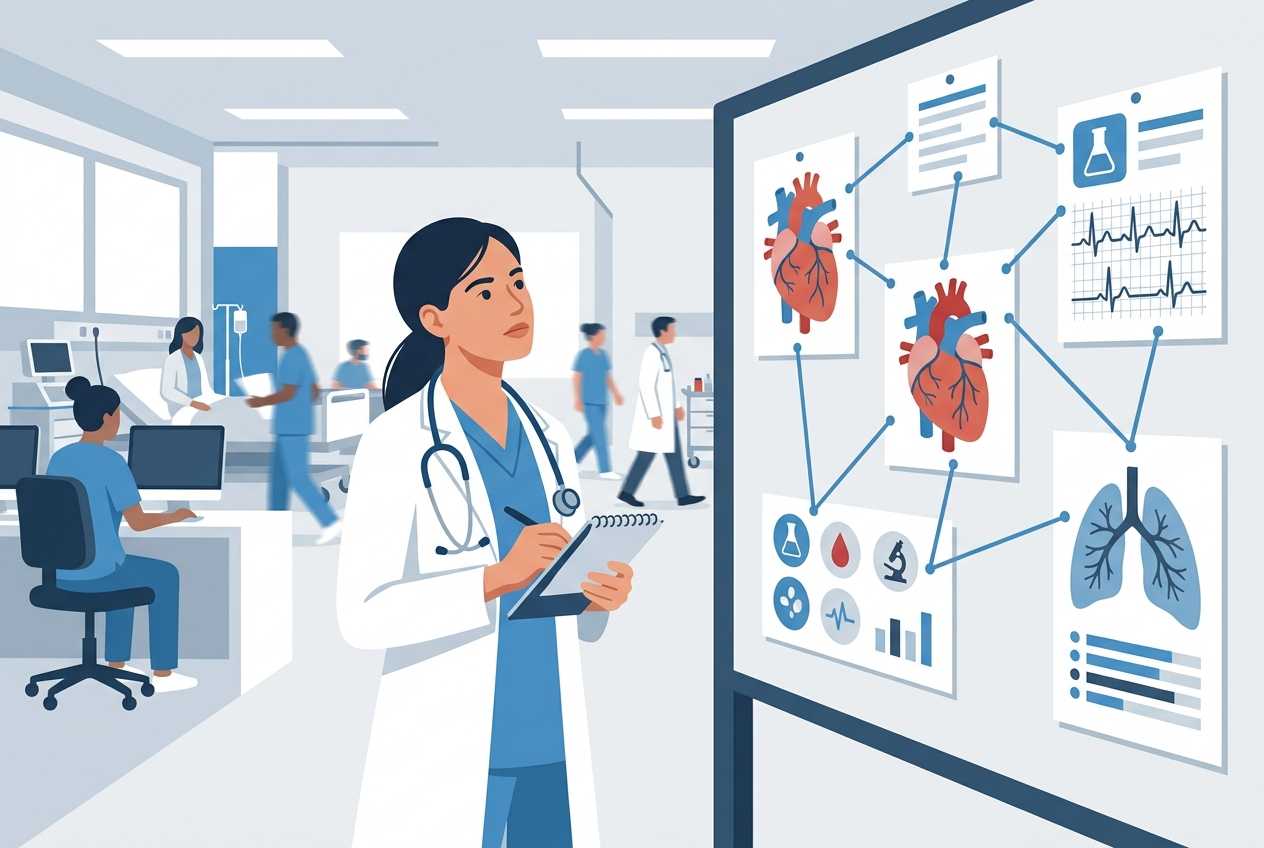
Students don't struggle because they can't memorize.
They struggle because they don't know how to think.
Textbooks organize medicine by diagnosis.
Real patients arrive with symptoms.
Students often memorize diseases instead of developing clinical reasoning.
MaldekChin reverses the learning process.
The answer is handed over first. Nothing left to solve.
The learner earns the diagnosis — the way it happens at the bedside.
Become the medical detective
A live patient is waiting. You get symptoms — not a diagnosis. Exactly like the real Emergency Department.
Data gathering & early hypothesis generation — most diagnoses are already suspected from the history alone, before a single test is ordered.
Hypothesis refinement — the exam is targeted by what the history made you suspect, not performed on autopilot. Each finding strengthens or weakens a hypothesis.
Hypothesis testing — order tests that discriminate between competing diagnoses, interpret them in context, and commit to a working diagnosis.
Pathophysiologic reasoning — connect years of mechanism to today's presentation, so the disease makes sense instead of being memorized.
Clinical decision-making — prioritize what kills first, choose interventions, avoid the classic traps, and plan past the emergency.
The difference students feel in week one
Faculty see the thinking, not just the score
Every click your students make inside a case becomes reasoning data — where they hesitated, what they missed, and who needs help before the exam reveals it.
24 / 30 active this week
87% median completion
Differential accuracy up 31%
Class average 84%
Mapped to AACN Essentials
6 students flagged for fluid-balance review
51 conditions, ED to community
Sections, assignments, due dates
From first meeting to campus-wide, in one semester
What programs report after a pilot
Request a Clinical Reasoning Pilot
Tell us about your program. We'll reach out within a few days to plan a live demonstration and pilot.
The future of nursing education isn't more memorization.
It's better clinical thinking.
Clinical reasoning education, built by an ED Family Nurse Practitioner.